
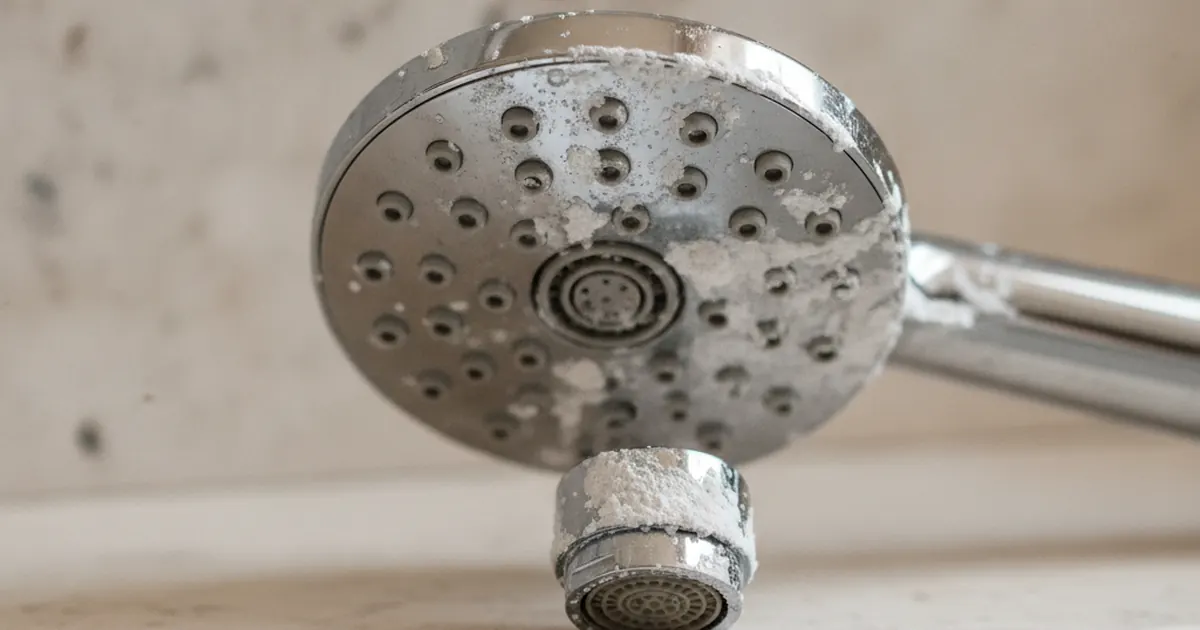
Gilbert's water is hard, which means it carries minerals that leave scale inside water heaters, faucets and shower valves. To protect your plumbing, flush your water heater regularly, check its anode rod, clean aerators and showerheads, and consider a water softener. A softener reduces scale everywhere water goes in the house.
What Hard Water Does to a Home
Hard water is water with a high mineral content, mostly calcium and magnesium. It's safe to drink. The problem is what happens when it's heated or left to dry on a surface. The minerals come out of the water and stick.
That buildup is called scale. You see it as white crust on faucets and glass doors. The damage you don't see is inside the plumbing.
Where scale causes trouble
- Water heaters. Sediment settles in the tank and coats heating parts.
- Tankless heat exchangers. Scale narrows the small passages and cuts output.
- Shower valves and cartridges. Parts stiffen, drip or stop mixing temperature properly.
- Faucet aerators and showerheads. Flow drops as openings clog.
- Toilet fill valves. Mineral deposits keep them from shutting off cleanly.
- Dishwashers and washing machines. Scale builds in valves and heating elements.
East Valley water is hard across every city we serve, from Gilbert and Chandler to Queen Creek and Mesa. Newer homes aren't spared. A 2010s home in Gilbert faces the same water as a 1970s home in Tempe.
Why heat makes it worse
Minerals come out of water faster when it's heated. That's why the water heater takes the worst of it. Every gallon of hot water leaves a little behind in the tank or the tankless heat exchanger. Over years, that adds up to a thick layer that the heater has to work through.
Early Signs Scale Is Building Up
You can catch hard-water damage early if you know what to look for. Most signs show up well before anything fails.
Around the house
- White crust on faucets, showerheads and glass
- Spotty dishes even with a rinse aid
- Showerheads with some nozzles blocked
- Faucets that drip after being turned off firmly
- A toilet that keeps running
At the water heater
- Popping or rumbling sounds while it heats
- Hot water that runs out sooner than it used to
- Gritty bits in hot water at faucets
- Longer waits for hot water than when the heater was new
At a tankless heater
- Hot water that swings in temperature
- Lower hot-water flow at several fixtures
- Error codes on the unit's display
A popping tank is the classic sign. It's the sound of water trapped under a layer of sediment, boiling as the burner heats through it.
In the kitchen and laundry
- Cloudy film on glasses after the dishwasher
- Laundry that feels stiff
- A slow-filling washing machine, often from clogged inlet screens
- An ice maker or refrigerator filter that clogs quickly
Any one of these is minor. Together, they tell you scale is working its way through the house.
Maintenance You Can Do Yourself
Several hard-water tasks are safe for most homeowners. Doing them on a schedule adds years to fixtures and appliances.
Clean aerators and showerheads
- Unscrew the aerator from the faucet tip.
- Soak it in white vinegar for an hour or two.
- Scrub it with an old toothbrush and rinse.
- For a fixed showerhead, tie a bag of vinegar around it overnight.
Flush a tank water heater
Flushing drains the sediment out of the bottom of the tank. If you're comfortable with it, the general steps are:
- Turn a gas heater to its pilot or vacation setting, or switch off the breaker for an electric heater.
- Close the cold-water supply valve to the heater.
- Attach a hose to the drain valve and run it outside.
- Open a hot-water faucet in the house, then open the drain valve.
- Let it drain until the water runs clear, then close the valve and refill before restoring power or gas.
Water in the tank is hot. Let it cool first, and follow the manufacturer's instructions for your model. If the drain valve is old and brittle, or won't close afterward, stop and call a plumber.
Watch the toilet fill valve
If a toilet runs or refills on its own, mineral buildup on the fill valve or flapper is a common cause. Replacing a flapper is a simple DIY job for most people.
When a Water Softener Makes Sense
Maintenance treats the symptoms. A softener treats the cause. It removes the hardness minerals before water reaches your heater and fixtures.
What a softener does and doesn't do
| A softener does | A softener doesn't |
|---|---|
| Reduce scale in heaters, valves and fixtures | Filter out every contaminant |
| Help soap and detergent work better | Make water taste better on its own |
| Cut down on white crust on glass and tile | Replace regular heater maintenance entirely |
| Protect appliances with water heaters inside | Fix scale that's already built up |
For drinking water, many Gilbert households add a reverse osmosis system at the kitchen sink. It filters water for drinking and cooking. It works well alongside a softener.
Other treatment options
- Whole-home filtration. Reduces chlorine taste and odor throughout the house.
- Reverse osmosis. Filters drinking water at one tap, usually the kitchen sink.
- Combination systems. A softener with filtration, set up for your water and your household.
Sizing matters
A softener should be sized for your household's water use and your water's hardness. Too small, and it runs out of capacity between cycles. Too large, and you pay for capacity you don't use. We size systems for the household and explain the options. There's more on our water softeners and whole-home treatment services.
Protecting a Tankless Water Heater
Tankless heaters are popular in Gilbert, and they handle hard water differently from a tank. There's no tank for sediment to settle in. Instead, scale forms on the heat exchanger, the coiled passage where water is heated as it flows through.
Why tankless units are sensitive to scale
- The water passages are narrow, so a thin layer of scale restricts flow.
- Scale insulates the heat exchanger, so the burner runs harder for the same result.
- Many units show error codes or shut down when scale gets heavy.
How to keep one running well
- Descale on schedule. A small pump circulates a descaling solution through the unit. Follow the manufacturer's interval for hard water.
- Clean the inlet filter. A small screen on the cold-water inlet catches grit.
- Install service valves if the unit doesn't have them. They make descaling quick.
- Consider a softener or a scale-reduction filter ahead of the heater.
If your tankless unit was installed without service valves, adding them is a small job that makes every future descaling easier. It's worth asking about at your next visit. A well-kept tankless unit gives steady hot water for years; a neglected one in hard water can lose output quickly.
What Affects the Cost
We don't publish prices, but these are the factors that move the number for hard-water protection. You get a clear number before any work begins, with free visual estimates on most jobs. If diagnosing the problem needs tools, camera work, testing or disassembly, a diagnostic fee may apply.
Cost for hard-water protection depends on how much of the house you want to protect and what's already plumbed in.
Cost drivers for a softener or filtration system
- System type and capacity. Larger households need more capacity.
- Loop location. Many newer homes have a softener loop already plumbed; older homes may not.
- Add-ons. Reverse osmosis at the kitchen sink or whole-home filtration.
- Drain and power access. A softener needs a drain and often an outlet nearby.
The cost of doing nothing
Scale doesn't send a bill, but it adds up.
- Shorter water heater life. Sediment makes the heater work harder every day.
- Early valve and cartridge repairs. Shower valves and toilet fill valves wear out sooner.
- Appliance wear. Dishwashers, washers and ice makers all run water through small valves.
- Cleaning time. Crust on glass and tile takes regular effort to remove.
For a lot of Gilbert homes, protecting the water heater alone makes treatment worth considering. We'll give you a straight recommendation, including when a softener isn't needed for your situation.
When to Call a Professional
Some hard-water fixes are DIY. Others need a licensed plumber.
Keep these as DIY
- Cleaning aerators and showerheads with vinegar
- Wiping down fixtures after use to slow crust buildup
- Replacing a toilet flapper
- Adding salt to an existing softener and checking its settings
Leave these to a plumber
- Shower valve cartridges. Scale-seized cartridges can break the valve body if forced.
- Tankless descaling when you don't have the pump kit or the unit shows error codes.
- A tank that won't drain. Heavy sediment can clog the valve.
- Softener installation without an existing loop. It needs new piping, a drain and bypass valves.
- Anode rod replacement. It's often seized in place and needs the right tools.
Leave these to a plumber too
- Replacing a relief valve that drips or won't open.
- Replacing corroded shutoff valves that no longer close fully.
Why it pays to get it checked
A plumber can spot scale damage you can't see, like a relief valve that no longer opens freely or a tank with a thick sediment layer. Catching those early is cheaper than replacing a heater on the day it fails. We'll show you what we find and explain the options, without steering you toward the most expensive fix.
Renova offers free visual estimates on most jobs. If your heater is already struggling, see our water heater repair services. For in-town help, see water softeners in Gilbert.
Need a Plumber in Gilbert? Renova Plumbing & Drain Is Ready to Help
Hard water is a fact of life here, but the damage it does is manageable. We'll check your heater and fixtures and give you a straight recommendation. Call or text (602) 502-6843 or send us a message.