
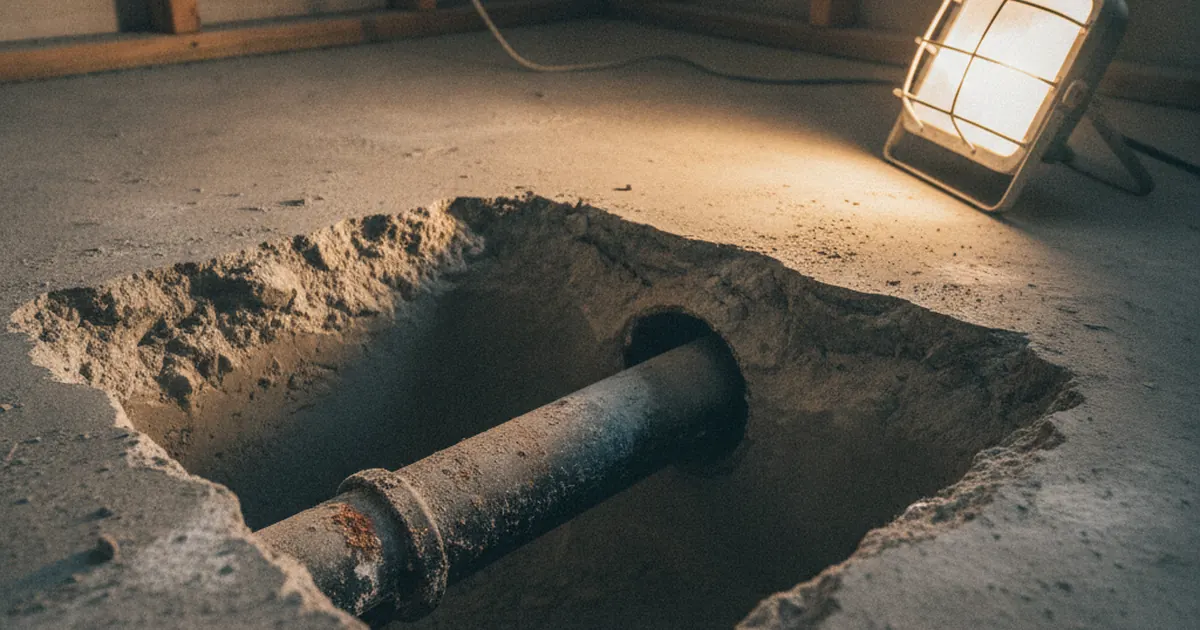
If your home was built before about 1980, the drains under your bathroom may be as old as the house. Before a remodel, look for slow drains, sewer smells, repeat clogs and old repairs. Then have the lines checked with a sewer camera. Replacing a failing drain while the floor is open costs far less than tearing out new tile later.
Why the Drains Matter More Than the Tile
A new bathroom is mostly what you see: tile, glass, a vanity, a good shower valve. But the part that decides whether it lasts is the part you never see. That is the drain system under the floor and behind the walls.
In many East Valley homes, that system is original. Much of north and central Tempe, South Scottsdale, west Mesa and north Chandler was built from the 1950s through the 1970s. Most of these homes sit on a concrete slab, with drain lines running underneath it.
What older homes usually have
- Cast iron drain lines. Common in homes built before about 1980. Strong, but it corrodes from the inside over decades.
- Older supply lines. Galvanized steel or early copper that may be narrowed or pitted.
- Past repairs. Mismatched pipe, rubber couplings and fixes done by a previous owner.
None of this means your pipes have failed. It means you don't know yet, and a remodel is the one time you can find out cheaply.
"A bathroom remodel is an investment. The plumbing behind the tile is what protects that investment." — Luke Williams
Most remodelers cover old plumbing with new tile. Most plumbers hand you off to someone else for the finished room. That gap is where problems get buried. If the walls are already open, this is the time to find out what condition the drains and water lines are actually in.
Warning Signs You Can Spot Yourself
You don't need special tools to notice the early signs. Walk through the house and pay attention to these.
Signs inside the bathroom
- Slow drains in the tub or sink. Especially if clearing the trap doesn't help.
- Gurgling after you flush. Air being pulled through a partly blocked line.
- A sewer smell near the toilet or tub. Can mean a cracked drain, a failed seal or a dry trap.
- Loose tile or a soft floor by the toilet. Slow leaks often show up this way first.
- Stains on the ceiling below an upstairs bath. A leaking drain, valve or supply line.
Signs elsewhere in the house
- Several fixtures slow at the same time. Points to the main drain, not one trap.
- Clogs that keep coming back. Clearing treats the symptom; the cause is often in the pipe itself.
- Water backing up into the tub when you run the washer. A shared line that is restricted downstream.
- Heavy black pipe at a cleanout or in the garage. A strong hint that the home has cast iron.
One of these alone is not proof of a failing line. Two or three together, in a home from the 1950s to the 1970s, is a good reason to look closer before you commit to a design.
What Actually Goes Wrong With Old Cast Iron
Cast iron was the standard drain pipe for decades. It is quiet and strong. Its weakness is time. Understanding how it fails helps you judge what an inspection shows you.
The common failure patterns
| Problem | What happens | What you notice |
|---|---|---|
| Internal corrosion | Rust and scale build up inside the pipe | Slow drains, repeat clogs |
| Channel rot | The bottom of the pipe wears thin along its length | Leaks under the slab, soft spots |
| Cracks | Pipe splits from age or ground movement | Odors, damp areas, backups |
| Sags or low spots | A section settles and holds water | Recurring clogs at one spot |
| Root intrusion | Roots enter through joints or cracks | Backups, especially in the main line |
Why the slab makes timing important
Because most East Valley homes are slab-on-grade, reaching a drain under the floor means cutting concrete. During a remodel, the bathroom floor is often coming up anyway. That changes the math.
Replacing a drain section in an open floor is a planned part of the job. Replacing the same section after new tile is down means breaking out the new floor, then paying to rebuild it.
Other things that speed up the wear
- Hard water. East Valley water carries a lot of minerals, and scale builds up inside older pipe.
- Grease and wipes. They catch on rough, corroded pipe walls and start clogs.
- Chemical drain cleaners. Repeated use is hard on aging cast iron.
- Past patch jobs. A short section of new pipe can hide a longer run that is failing.
How an Inspection Works Before a Remodel
Guessing is expensive in both directions. Replace everything by default and you may spend money on pipe that had years left. Replace nothing and you risk burying a failing line. An inspection gives you facts.
The steps
- Talk it through. We ask about your plans, the age of the home and anything you have noticed.
- Camera inspection. A small waterproof camera goes into the drain and shows the pipe from the inside.
- Locating. We trace the camera from above to mark where a problem sits under the floor.
- Supply line check. We look at the water lines feeding the bathroom and test pressure where it makes sense.
- Plain-language findings. You see the footage and hear what it means.
We'll show you what we find, explain the options, and recommend the repair that makes sense for the home. If the cast iron is sound, it stays. Admitting when replacement isn't needed is part of the job.
What the footage tells you
- The pipe material, whether cast iron, clay, ABS or PVC
- Scale, corrosion and any cracks
- Low spots that hold water
- Roots or foreign objects
Learn more about our sewer camera inspection services and how we approach cast iron drain replacement.
What Affects the Cost
We don't publish prices, because every older home is different. What we can tell you is what moves the number. You get a clear, line-item scope and estimate before anything is committed, so there's no guessing. If diagnosing the problem needs tools, camera work, testing or disassembly, a diagnostic fee may apply.
The main cost drivers
- Condition of the drains. Sound pipe adds nothing. A failing line under the slab adds real work.
- How much pipe is involved. One section under the bathroom versus a run to the main line.
- Moving fixtures. Relocating a toilet or shower means new drain routes through concrete.
- Supply line condition. Old galvanized lines may need replacing back to the main.
- Access. Floors that are already open cost less to work in than finished ones.
- Permits. Drain and remodel plumbing often need one; Renova coordinates it for the plumbing scope.
What to watch for in a low quote
A quote that seems low often leaves the drains out entirely. It prices the tile and fixtures and assumes the plumbing underneath is fine. Ask any contractor directly: will you inspect the drains before demolition, and what happens if you find a problem halfway through?
You should get a clear, line-item scope before anything is committed. That is how you avoid a surprise change order once the floor is open.
Planning the Remodel Around What You Find
The inspection is only useful if the plan changes to match it. This is where one team handling both the plumbing and the bathroom makes a real difference.
If the drains are sound
Good news, and it happens. The design goes ahead as planned, and your budget goes into the finished room. We still test every new connection before the floor or walls are closed.
If some sections are failing
We mark the problem spots and build the repair into the demolition plan. The floor comes up once. The bad pipe comes out, new pipe goes in, and it gets tested before concrete and tile go back.
If you want to move fixtures
Moving a toilet or shower changes the drain route. That means new pipe through the slab, with the right slope and venting. It's the ideal time to replace old pipe along the same path.
Questions to ask before you sign
- Will the drains be inspected before demolition?
- Who decides what gets replaced, and will I see the footage?
- What happens to the schedule if a problem is found?
- Is the plumbing scope permitted and inspected?
- Is the same team doing the plumbing and the finish work?
Clear answers to these questions protect your budget more than any single material choice.
When to Call a Professional
Some checks are fine to do yourself. Others need a licensed plumber.
What you can do
- Note which drains are slow and when it happens.
- Look for heavy black pipe at cleanouts or in the garage.
- Check under sinks and around the toilet base for dampness.
- Pour water into an unused floor drain or tub to refill a dry trap if you smell sewer gas.
What to leave to a plumber
- Cutting into drain lines. Cast iron is heavy and joints need the right fittings.
- Anything under the slab. Locating and cutting concrete takes the right tools.
- Chemical drain cleaner on old pipe. It rarely fixes the cause and can be hard on aging cast iron.
- Moving fixtures. Drain slope and venting have to be right or the new bathroom will drain poorly.
If you are already planning a remodel, call early. The best time to call a plumber about your remodel is before you've finalized the design. Remodel projects book out, sometimes several weeks, so reaching out early also helps hold your spot.
Renova handles both halves of the job. Our bathroom remodeling in older homes starts with the plumbing, and we work across Tempe, Mesa, Scottsdale and Chandler. If you live in Tempe, see older-home bathroom remodeling in Tempe.
Need a Plumber in Tempe? Renova Plumbing & Drain Is Ready to Help
Old drains don't have to derail a new bathroom. We inspect first, fix only what needs it, and build the finished room with one licensed team. Call or text (602) 502-6843 or send us a message to talk through your remodel.