
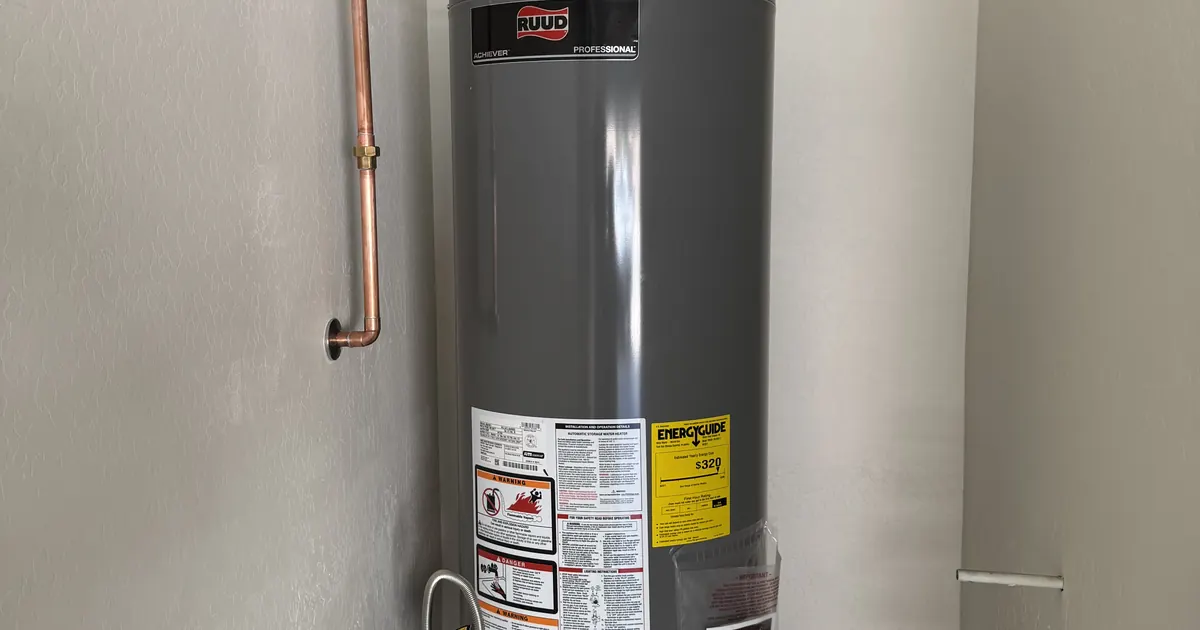
The cost of replacing a water heater in Gilbert depends on the type and size of heater, gas or electric, where it sits, and what has to be brought up to current code. Tankless costs more upfront than a tank. A fair quote lists every part and task, so you can compare quotes by what's actually included.
Why Gilbert Water Heaters Are Due Now
Most of Gilbert was built from the 1990s on. Many homes still run the water heater the builder installed, or a first replacement from years ago. Those heaters are reaching the end of their life across town.
Two local conditions speed that up.
- Hard water. Minerals settle in the tank and coat heating parts, so the heater wears out sooner.
- Heat. Many heaters sit in garages that bake in summer, which adds stress to parts and connections.
Put together, that means many heaters here don't reach the age their label suggests.
Signs yours is close to the end
- Rusty or discolored hot water
- Popping or rumbling from the tank
- Hot water that runs out faster than it used to
- Moisture or rust around the base
- A heater that is simply old and has never been serviced
Repair or replace?
- Leak from the tank itself. Usually means replacement.
- Bad thermostat, element or gas valve. Often repairable.
- Worn relief valve or drain valve. Usually a simple repair.
- An old heater with several problems. Replacement is often the better use of money.
We'll tell you honestly which one you're looking at, including when a repair makes more sense than a new heater.
The Biggest Cost Drivers
We don't publish prices, because the right answer depends on your home. If diagnosing the problem needs tools, camera work, testing or disassembly, a diagnostic fee may apply. These are the factors that move the number most, in roughly the order they matter.
| Factor | Why it changes the cost |
|---|---|
| Tank or tankless | Tankless units cost more and often need gas, venting and electrical changes |
| Gas or electric | Gas needs venting and a gas connection; electric needs the right circuit |
| Size | A larger tank or higher-output tankless unit costs more |
| Location | Attic, closet or tight garage installs take more time |
| Code updates | Older installs may need a drain pan, expansion tank or venting changes |
| Switching fuel type | Going from electric to gas, or the reverse, adds significant work |
Tank versus tankless
A standard tank heater is the simpler swap. The new unit usually goes where the old one was, on the same connections.
A tankless heater heats water only when you use it. It saves space and doesn't run out of hot water. But the switch often involves a larger gas line, new venting, a new electrical outlet and a different mounting spot. In hard water, a tankless unit also needs regular flushing to keep scale off its heat exchanger.
| Tank | Tankless | |
|---|---|---|
| Upfront cost | Lower | Higher |
| Hot water supply | Limited by tank size | Continuous |
| Space | Floor space in garage or closet | Wall-mounted, compact |
| Hard-water care | Regular flushing | Regular descaling |
| Install work | Usually a direct swap | Often gas, venting and electrical changes |
Neither is right for every home. Our tankless water heater installation page explains how we decide.
Gas versus electric
Most Gilbert homes with gas already have a gas water heater. Staying with the same fuel keeps the job simpler. Changing fuel type means running new gas or electrical lines, and that is where costs climb.
Sizing for your household
A heater that is too small runs out of hot water. One that is too big costs more to buy and run. Sizing depends on how many people live in the home, how many bathrooms run at once, and whether you have a large tub. We size the heater to how you actually use water.
What a Proper Quote Should Include
Two quotes can look far apart and still be for different jobs. Before you compare prices, compare what's on the page.
A complete quote covers
- The heater itself. Brand, model, size and fuel type written out.
- Removal and disposal of the old heater.
- New connections. Water lines, gas connector or electrical hookup as needed.
- Venting for gas units, checked and corrected where needed.
- Code items. Drain pan, expansion tank, pressure relief line and seismic or support needs.
- Permit coordination when the city requires one for the plumbing scope.
- Testing. Leaks, gas connections, relief valve and water temperature checked before we leave.
What cheap quotes tend to skip
- The expansion tank. Homes with a pressure regulator often need one. Leaving it off stresses the new heater.
- Relief valve piping. It should drain to a safe place, not just stop short.
- Venting corrections. Reusing a vent that doesn't fit the new unit is a safety problem.
- The permit. Some jobs need one. Skipping it can cause trouble when you sell the home.
- A real explanation. You should know why a part is needed, not just that it is.
At Renova, you get a straight recommendation based on your home and your budget, not on whatever has the highest margin. You'll hear back from our local team, not a call center. See our water heater replacement services for how the job runs.
How Hard Water Affects Your Long-Term Cost
The upfront quote is only part of the cost. How long the new heater lasts matters just as much, and in Gilbert that comes down to hard water.
What scale does
- Sediment builds a layer at the bottom of a tank. The burner or element has to heat through it.
- Scale coats the inside of a tankless heat exchanger and reduces its output.
- Minerals wear out valves, anode rods and relief valves sooner.
Ways to protect the new heater
- Flush the tank on a regular schedule to clear sediment.
- Check the anode rod, the metal rod inside the tank that corrodes so the tank doesn't.
- Descale a tankless unit as the manufacturer recommends.
- Consider a water softener, which reduces scale throughout the house, not just in the heater.
A softener is especially worth considering if you're choosing tankless, because scale on the heat exchanger is the most common reason those units lose output.
Maintenance by heater type
| Heater | Routine care |
|---|---|
| Gas tank | Flush sediment, check anode rod, check venting and burner |
| Electric tank | Flush sediment, check anode rod and elements |
| Tankless | Descale heat exchanger, clean inlet filter |
A softener is its own decision with its own cost. For many Gilbert homes it's worth it, because it also protects fixtures and appliances. Our water softeners and whole-home treatment page covers the options.
Planning Ahead Saves Money
Most water heaters get replaced in a hurry, on the day the old one leaks. That's the hardest time to compare options. If yours is getting older, a little planning helps.
What planning ahead lets you do
- Compare tank and tankless calmly, instead of taking whatever is on the truck.
- Plan gas or electrical changes if you want to switch to tankless.
- Add a softener at the same time, so the new heater starts on softer water.
- Pick the right size for how your household uses water now.
- Schedule the work at a time that suits you.
Signs it's time to start planning
- The heater is past the age on its label and has never been flushed.
- You hear popping or rumbling more often.
- Hot water runs out sooner than it did a year ago.
- You see rust at the connections or the base.
- The heater is in an attic or closet where a leak would do serious damage.
A quick look from a plumber can tell you whether you have time or whether the tank is close to failing. Either way, you get to decide with the facts in front of you, not in a rush with water on the garage floor.
When to Call a Professional
A few water heater tasks are reasonable for a handy homeowner. Most are not.
Knowing where that line sits keeps you safe and keeps the new heater covered by its manufacturer's terms, which often require professional installation.
What you can do
- Check the temperature setting and look for moisture around the base.
- Test the relief valve by lifting its lever briefly, with a bucket below.
- Keep the area around the heater clear, especially around a gas unit.
- Note the age from the label, which is usually coded into the serial number.
What to leave to a licensed plumber
- Anything involving gas. Gas connections and venting must be done and tested correctly.
- Replacing the heater. It involves water, gas or high-voltage electrical, and often a permit.
- Relief valve replacement. This valve protects the tank from overpressure.
- Switching to tankless. Gas sizing, venting and mounting need to be planned.
Questions to ask any plumber
- Is the quote for the same size and type of heater as the others?
- Does it include an expansion tank, drain pan and venting check?
- Who pulls the permit if one is needed?
- Will you haul away the old heater?
- Who do I call if something isn't right afterward?
Renova is licensed, bonded and insured, with free visual estimates on most jobs. If you're in town, see our page on water heater replacement in Gilbert.
Need a Plumber in Gilbert? Renova Plumbing & Drain Is Ready to Help
A water heater quote should tell you exactly what you're paying for. We'll look at your current setup, explain the options and give you a clear number before any work begins. Call or text (602) 502-6843 or send us a message.